Sampling parametric surfaces in 3D
A parametric surface maps two parameters to a spatial point: \(F(u,v)=(x(u,v),y(u,v),z(u,v))\). It provides surface samples and normals, without sampling an enclosed volume or constructing surface triangles. Use this path when the requested unknowns live on a surface; a volume mesh or tetrahedral connectivity is not implied by the parametrization.
Example: a torus
The major radius R measures the distance from the axis to the tube center;
the minor radius r measures the tube radius. Choose R > r > 0 for this ring torus.
import numpy as np
from rbflab import meshgen, viz

R, r = 1., .35
surface = meshgen.ParametricSurface3D(
    lambda u,v: ((R+r*np.cos(v))*np.cos(u),
                 (R+r*np.cos(v))*np.sin(u), r*np.sin(v)),
    u_range=(0,2*np.pi), v_range=(0,2*np.pi),
    periodic_u=True, periodic_v=True, label="torus",
    derivatives=(
        lambda u,v: (-(R+r*np.cos(v))*np.sin(u),
                      (R+r*np.cos(v))*np.cos(u), 0*u),
        lambda u,v: (-r*np.sin(v)*np.cos(u),
                     -r*np.sin(v)*np.sin(u), r*np.cos(v)),
    ),
)
cloud = meshgen.generate(surface, interior=0, boundary=900, seed=42)
fig, ax = viz.plot_cloud(cloud)
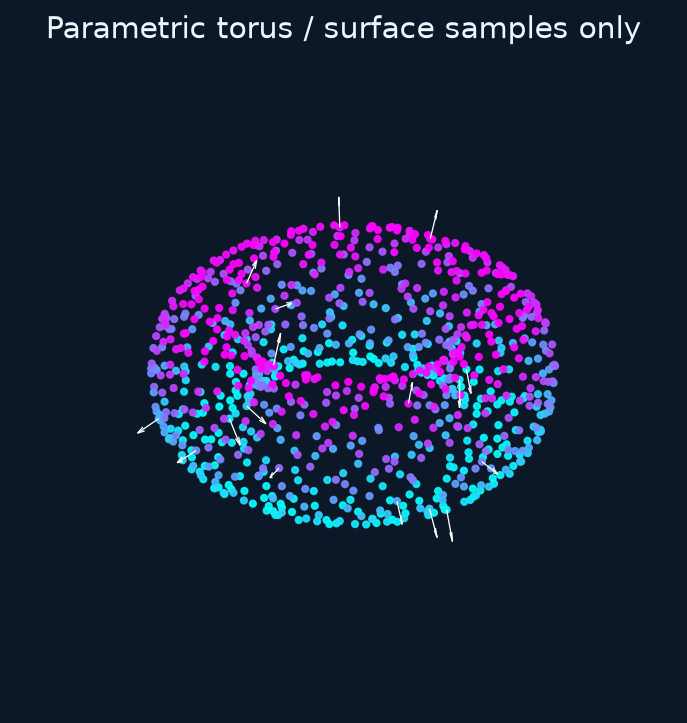
interior=0 is required: this input describes a surface, not a volume.
All generated points belong to its label. The unified generator leaves the
surface object's stored samples unchanged and returns a regular 3D PointCloud.
Parameters and normal convention
u_range,v_range: finite increasing parameter intervals.periodic_u,periodic_v: declare a periodic seam; numerical derivatives wrap there.derivatives: optional pair of callables \((F_u,F_v)\). Without them, derivatives are approximated numerically by the surface implementation.orientation=1: normals follow \(F_u\times F_v\); use-1to reverse them.label: the name of the sampled surface group.
The normalized cross product is the normal. Its orientation is defined by the parameterization; there is no enclosing volume here from which to infer “outward.” At a parameter singularity, the cross product may vanish and sampling is unsuitable. Choose a regular parameterization or split it into appropriate patches.
Why uniform parameters are not uniform surface area
The area factor is \(J(u,v)=\lVert F_u\times F_v\rVert\). The sampler weights
acceptance by this Jacobian so large physical patches receive more samples than
small patches with the same parameter area. This is area-weighted sampling, not
a minimum-spacing guarantee. max_candidates controls the sampling search budget.
The surface API currently takes callables; the new symbolic planar-curve API is separate. Sampling a surface does not automatically implement a surface PDE or a Laplace–Beltrami operator. Use 3D volumes for ordinary volume PDEs.