Boundary labels and outward normals
A label identifies a boundary group; a normal identifies the direction out of the material at each group sample. Neither imposes a PDE equation by itself. Later, a model can assign a condition to a name such as wall or inlet.
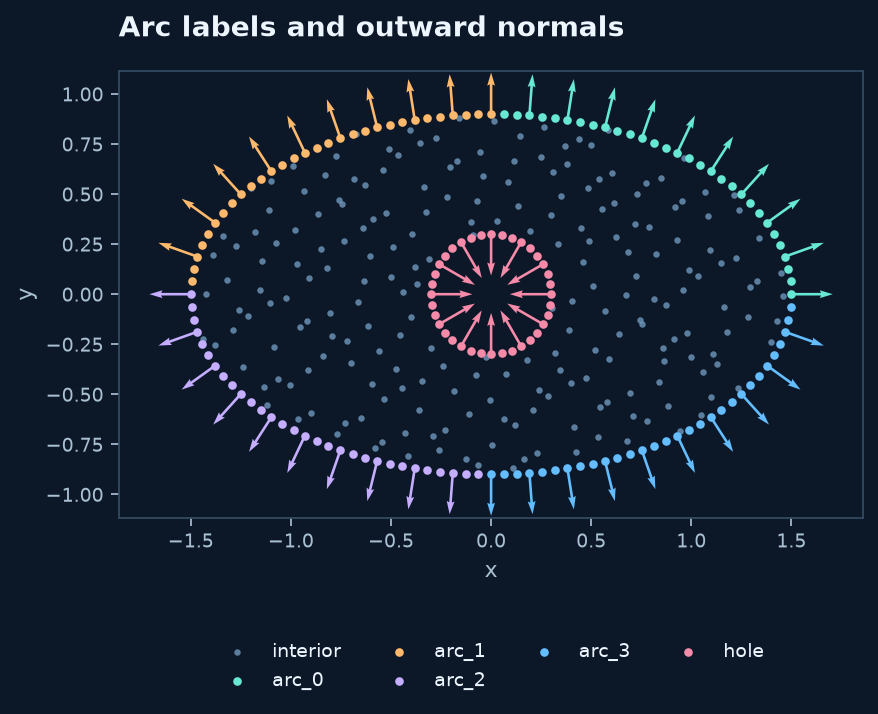
Split where the boundary role changes
from rbflab import geometry as g, meshgen, viz

domain = g.with_holes(
    g.Ellipse(1.5, .9, labels=("arc_0", "arc_1", "arc_2", "arc_3")),
    {"hole": g.Disk(.3)},
)
cloud = meshgen.generate(domain, interior=220, boundary={
    "arc_0":30, "arc_1":30, "arc_2":30, "arc_3":30, "hole":36,
})
fig, ax = viz.plot_cloud(cloud, normals=True)
Each cloud.boundary[label] contains indices into cloud.points; cloud.normals[label] has matching rows. For a hole, outward-from-material points into the removed region.
Why orientation depends on material
For a regular curve gamma(t)=(x(t),y(t)), a right-hand unit normal is
The material determines whether this or its negative is outward. Therefore the same circle has opposite outward directions as an exterior boundary and as a hole. ParametricDomain knows the contour role; in a Border collection, signed traversal helps classify positive outer contours and negative holes. See the border workflow.
Choose a derivative source
Symbolic expressions are differentiated once. A callable may provide tangent=...; otherwise RBFLAB uses second-order finite differences with one-sided stencils near interval endpoints. The same choices are available to Border and ParametricBoundary.
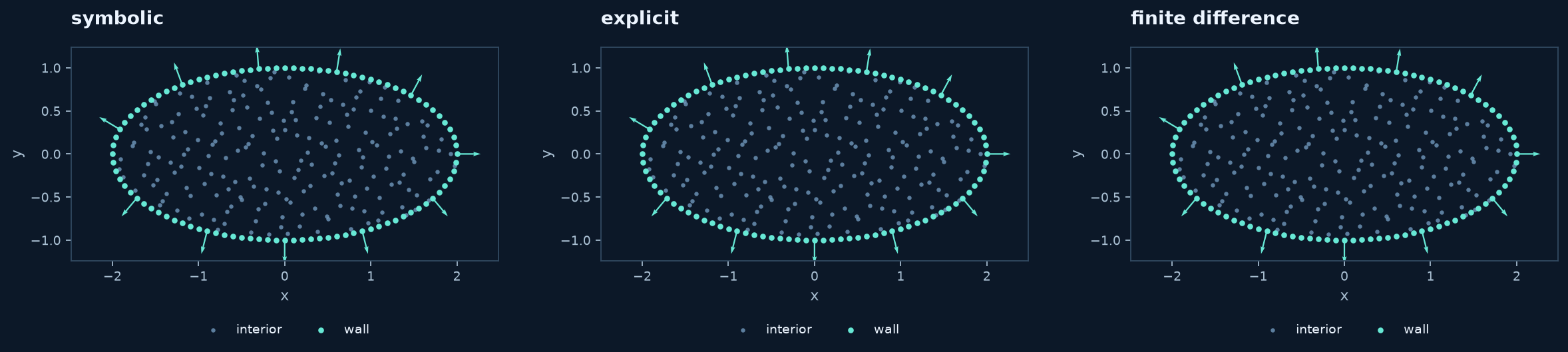
For sensitive flux conditions, prefer symbolic or supplied derivatives. Numerical differentiation can lose accuracy for badly scaled parameters, noisy functions, corners, cusps, or vanishing tangents. difference_step is in parameter units and must be positive and no more than a quarter of the parameter interval. A finite normal is not an accuracy guarantee.
Override normals explicitly
At curve level, normal(t) uses the curve parameter. At cloud level, a callback receives the boundary coordinates:
import numpy as np
cloud = meshgen.generate(
    g.Annulus(.35, 1.), interior=200,
    boundary={"inner":40, "outer":80}, seed=42,
    normals={"inner": lambda p: -p / np.linalg.norm(p, axis=1)[:, None]},
)
Overrides are normalized and their direction is preserved; RBFLAB does not flip an explicit vector to make it outward. Cloud-level overrides take precedence over curve normals. Provide finite, nonzero vectors matching the boundary coordinate array shape.
Junction ownership
For piecewise boundaries, the starting arc owns a shared junction. Its normal supplies the value at that point; there is no corner average and the other incident edge does not contribute a second node there. Treat corner equations deliberately, especially when the solution is not smooth.